


Chat with MASLD AI

Hi, I am MASLD AI.
Suggested Questions :
MASLD AI 03:03 AM

 November 2025

In this educational video, Summer Collier, MSN, FNP-BC, from UC San Diego Health, answers two of the most common questions she receives from patients with MASLD and MASH. She explains whether all patients with MASLD or MASH progress to advanced fibrosis and emphasizes the importance of early awareness, risk assessment, and proactive lifestyle counseling to help prevent disease progression. Summer also shares practical dietary guidance, highlighting the benefits of a Mediterranean-style or diabetes-friendly diet that limits sugary foods and beverages while focusing on long-term sustainability and cultural fit. This concise discussion offers real-world insights for clinicians and APPs looking to better counsel and support patients at risk for metabolic liver disease.
Related FAQ
Common Questions From Primary Care Providers About MASH
 November 2025
Join Renee Pozza, a hepatology nurse practitioner with over 25 years of experience, as she answers two of the most common questions advanced practice providers face in managing metabolic-associated steatotic liver disease (MASLD) and metabolic-associated steatohepatitis (MASH). In this educational discussion, Renee explains how primary care NPs and PAs can identify patients at risk for fatty liver disease, what non-invasive tests—such as FIB-4 and FibroScan®—can be performed in various clinical settings, and when it’s appropriate to refer patients to hepatology for further evaluation. She also outlines key lifestyle modification strategies for patients with MASLD or MASH, including weight management, exercise, diabetes control, and multidisciplinary support to reduce disease progression and improve long-term liver outcomes. For more expert guidance, educational videos, and clinical tools for APPs in hepatology, visit the MASLD Community Network to access additional resources and upcoming programs.
Watch Now
Common Questions From Primary Care Providers About MASH
July 2025
In this informative session, Jennifer Geremia, PA-C, a seasoned gastroenterology physician assistant in tertiary care Boston, addresses some of the most common questions primary care providers have about identifying and managing patients with fatty liver disease, MASLD (Metabolic dysfunction-associated steatotic liver disease), and MASH (Metabolic-associated steatohepatitis). Jennifer highlights the importance of using FIB-4 as a first-line non-invasive test (NIT) in high-risk patients with diabetes, obesity, or other metabolic conditions—noting how easily this tool can be integrated into routine labs via the EMR. She underscores that the liver is often overlooked in chronic disease management and makes a strong case for routine fibrosis screening alongside cardiovascular and diabetes evaluations. The talk also dives into actionable next steps after FIB-4 testing, including elastography, ELF testing, and referrals to GI when needed. Jennifer closes by discussing realistic lifestyle intervention goals—especially the importance of 7–10% weight loss for meaningful reductions in steatosis and fibrosis risk. This session is a must-watch for PCPs, APPs, and clinicians managing metabolic comorbidities and seeking practical, evidence-based strategies for early MASH detection and management.
Watch Now
Common Questions From Patients About MASH
July 2025
In this practical and patient-focused discussion from the GHAPP MASLD/MASH Community Network, we address some of the most frequently asked questions by patients newly diagnosed with MASLD (Metabolic dysfunction-associated steatotic liver disease). Many patients wonder how they can have liver disease if they don’t drink alcohol. This video explains the evolution from NAFLD to MASLD, emphasizing that MASLD is rooted in metabolic risk factors—not alcohol use—and commonly affects individuals with diabetes, obesity, and hypertension. Viewers will also learn about evidence-based lifestyle interventions, including the benefits of a hypocaloric diet, the recommended Mediterranean-style eating pattern, and 150 minutes of weekly physical activity. Finally, we tackle the question “Is MASLD curable?” with empowering guidance on how weight loss and exercise can help reverse liver damage and reduce liver fat. This is a must-watch for clinicians, care teams, and patients seeking clarity and confidence in managing this increasingly common liver disease.
Watch Now

Misconceptions About Liver Health
June 2025
In this video, Gabriella McCarty, NP-C at Oshi Health, tackles common misconceptions surrounding fatty liver disease, also known as MASLD (Metabolic Dysfunction–Associated Steatotic Liver Disease). Drawing from her clinical experience, Gabriella highlights how fatty liver is often an incidental finding during routine GI visits, even when patients present for unrelated concerns like GERD or colon screenings. She emphasizes that MASLD is not caused by alcohol, but instead driven by metabolic risk factors such as obesity, diabetes, high cholesterol, and hypertension. Gabriella dispels the myth that normal liver enzymes indicate a healthy liver, explaining that liver markers are often unreliable in detecting advanced fibrosis or cirrhosis. She also warns against unregulated liver detox products and the outdated belief that fatty liver is harmless. With MASLD now the most common liver disease worldwide and increasing rates among younger populations, Gabriella stresses the importance of early screening, lifestyle modification, and patient education. This is a must-watch for anyone looking to better understand the silent progression of fatty liver disease and the tools available for timely intervention.
Watch Now

Common Questions from Primary Care Providers About MASH
July 2025
In this FAQ session, Brian Lam, PA-C, breaks down a common question he receives from primary care providers, endocrinologists, and even other GI specialists: Which patients with fatty liver should be referred to hepatology or GI for further evaluation? Using a clear and practical approach, Brian explains how to apply FIB-4, a simple lab-based non-invasive test, to guide referrals. He emphasizes that patients with metabolic syndrome—especially those with diabetes—are at significantly higher risk for MASH (Metabolic dysfunction-associated steatohepatitis), with roughly 1 in 3 diabetic patients affected. If the FIB-4 is greater than 1.3, or greater than 2.0 in adults over 65, it's time to refer. Brian also highlights the utility of FIB-4 with reflex to ELF, now available through major labs like LabCorp and Quest, as an efficient two-step method to detect advanced fibrosis and at-risk MASH. This video is perfect for busy clinicians looking for a referral-friendly workflow to catch MASH early and improve liver health outcomes in high-risk populations.
Watch Now

Common Questions from Primary Care Providers About MASH
July 2025
In this educational video, Erin Parkinson, APRN at the Transplant Institute at Tampa General Medical Group, addresses two of the most frequently asked questions from primary care providers about MASLD (Metabolic dysfunction-associated steatotic liver disease) and MASH (Metabolic-associated steatohepatitis). First, she explains when it’s appropriate to refer a patient to GI or hepatology, emphasizing the use of FIB-4 for risk stratification and recommending referral when scores are indeterminate or high, especially if a FibroScan® result shows ≥8 kPa. Erin also discusses lifestyle interventions, reinforcing the importance of weight loss and dietary modification, with strong endorsement of the Mediterranean diet—a recommendation supported by major liver societies. She also notes that intermittent fasting may be a helpful adjunct for patients seeking to improve liver health through sustainable weight reduction. This video provides practical tools for frontline providers to improve early detection and management of fatty liver disease.
Watch Now

Common Questions From Patients About MASH
August 2025
Discover practical insights into managing fatty liver disease from Melissa Franco, PA, a hepatology expert at the University of Miami. In this MASLD Community Network episode, Melissa answers one of the most common questions from patients: what causes fatty liver and how to improve it. She explains the multiple factors that can lead to fatty liver, including lifestyle, diet, genetics, alcohol use, and certain medications, and emphasizes the critical role of dietary modifications and regular exercise—often recommending the Mediterranean diet. Melissa also addresses alcohol use in patients with fatty liver, sharing why she discourages it entirely due to its potential to accelerate fibrosis progression, even at mild intake levels. Learn why personalized nutrition, physical activity, and avoiding alcohol are key steps in slowing disease progression and protecting liver health. Whether you’re a patient, caregiver, or healthcare professional, this video offers clear, evidence-based guidance on managing fatty liver disease effectively.
Watch Now
Misconceptions About Liver Health
July 2025
In this quick myth-busting session, Elizabeth Alqueza, PA-C from Beth Israel Deaconess Medical Center in Boston, addresses two of the most common misconceptions in hepatology related to steatotic liver disease (MASLD/MASH). First, she explains that liver disease is not always fixed or irreversible—and with proper management and elimination of the underlying cause, liver fibrosis can improve over time, a trend often monitored through FibroScan®. Second, she clarifies that significant liver improvement does not require extreme weight loss. In fact, a modest 5–10% reduction in total body weight—sometimes as little as 10–20 pounds—can lead to measurable improvements in liver inflammation and fibrosis. This video is ideal for providers and patients seeking a clearer understanding of how lifestyle changes can reverse liver disease and why timely, targeted interventions matter.
Watch Now

Misconceptions About Liver Health With April Morris
August 2025
Liver health is often misunderstood, with many patients and even providers believing that elevated liver enzymes mean certain medications are unsafe. In this video, April Morris, a family nurse practitioner specializing in hepatology and endocrinology, clears up misconceptions about liver disease and medication safety. She explains why evaluating overall liver function—through markers like bilirubin, albumin, and platelet counts—is far more important than looking at liver enzymes alone. April also emphasizes that many commonly prescribed medications, including statins and metformin, are generally safe for patients with liver conditions when monitored properly. Beyond medications, she highlights the powerful role of lifestyle modifications—reducing alcohol intake, managing carbohydrates and sugar, focusing on healthy nutrition, and incorporating exercise. These changes, she explains, can dramatically improve outcomes for patients with fatty liver disease (MASLD/MASH), diabetes, and other metabolic conditions. April underscores that patients hold the power to protect their liver health, but education and awareness are essential since liver disease can often remain a “silent killer” until it’s too late. Watch now to gain expert insights on how to better understand liver labs, avoid common myths, and take proactive steps to support long-term liver function.
Watch Now
Common Questions From Primary Care Providers About MASH
October 2025
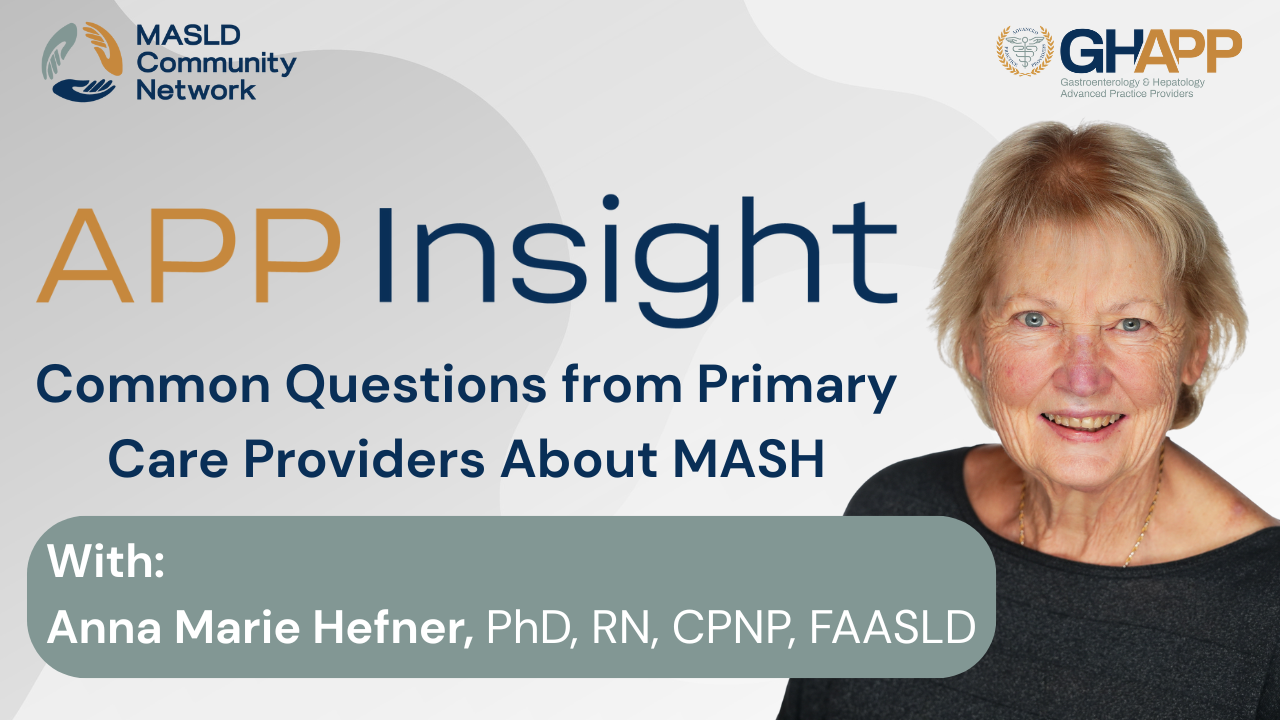
In this educational video, Anna Marie Hefner, CPNP, a hepatology nurse practitioner at the Southern California Liver and GI Centers, shares valuable insights for primary care providers managing patients with fatty liver disease. Anna Marie explains how her community-based practice collaborates with local clinicians to streamline care for patients with MASLD (Metabolic Associated Steatotic Liver Disease) and MASH (Metabolic Associated Steatohepatitis). She outlines a clear approach for evaluating patients with elevated liver enzymes and fatty liver, including when to use non-invasive testing (NITs) such as FibroScan and how to interpret fibrosis stages (F0–F4) to guide next steps in management. Anna Marie emphasizes that patients with early-stage fibrosis (F0–F1) can often be managed in primary care with regular weight monitoring, labs, and annual imaging, while those with advanced fibrosis (F3–F4) require hepatology referral for specialized care and cirrhosis management. She also discusses how her team supports community physicians—offering FibroScan services, consultative guidance, and direct communication to ensure patients receive coordinated, evidence-based care. This session is a practical resource for APPs, hepatology teams, and primary care providers navigating fatty liver disease screening, risk stratification, and referral pathways.
Watch Now