


Chat with MASLD AI

Hi, I am MASLD AI.
Suggested Questions :
MASLD AI 07:03 AM

 October 2025

Tuesday Werner, NP, explains why accurately identifying F3 vs F4 fibrosis is critical in patients with MASLD/MASH. Using real patient case comparisons, she highlights how non-invasive tests like FIB-4, FibroScan, and ELF help determine disease severity, guide treatment, and reduce the need for biopsy. Tuesday reviews how care strategies differ—F3 patients focus on aggressive metabolic control and fibrosis monitoring, while F4 (cirrhosis) requires HCC surveillance, closer specialist follow-up, and potential transplant evaluation.
Related Webcast
Webcast: Comparing F3 and F4 Fibrosis With Maly Tiev
 September 2025
Maly Tiev, NP, reviews two real-world cases to explain the critical differences between F3 advanced fibrosis and F4 cirrhosis in patients with MASLD/MASH, and how accurate staging changes treatment, prognosis, and surveillance strategies. Using non-invasive tests (NITs) such as FIB-4, FibroScan/Liver Stiffness (kPa), CAP, and the ELF test, she demonstrates how concordant results can guide management without biopsy, when discordant results may require further imaging or histology, and why platelet count and bilirubin trends are key for identifying cirrhosis. For patients with F3, Maly highlights the importance of lifestyle modification with 7–10% weight loss, diet and exercise counseling, optimization of type 2 diabetes and lipid control, potential use of GLP-1 therapy, and when resmetirom (FDA-approved for MASH with F2–F3 fibrosis) may be considered, along with repeat NITs for monitoring. For patients with F4, management shifts to cirrhosis care, including twice-yearly HCC surveillance (ultrasound ± AFP), variceal screening guided by liver stiffness and platelet thresholds, and strict emphasis on alcohol avoidance and cardiometabolic risk reduction, noting that resmetirom is not used in cirrhotic patients. This case-based discussion provides clinicians, APPs, and hepatology teams with practical tools to approach staging, risk stratification, and surveillance in MASLD/MASH.
Watch Now
Webcast: MASLD Basics With Gabriella McCarty
August 2025
In this educational session, Gabriella McCarty, NP-C at Oshi Health, shares practical insights into Metabolic Dysfunction-Associated Steatotic Liver Disease (MASLD) and MASH. Drawing from over 25 years of experience in GI, IBD, and hepatology, she explains how many fatty liver patients are discovered incidentally during workups for unrelated issues such as GERD or routine colonoscopy. Gabriella reviews the new global terminology (MASLD replacing NAFLD, MASH replacing NASH), outlines key metabolic risk factors that define MASLD, and walks through the role of non-invasive tests (FIB-4, FibroScan, ELF, ultrasound) in staging fibrosis. She emphasizes the importance of early detection, patient education, and primary care involvement in identifying at-risk individuals before progression to advanced fibrosis, cirrhosis, or liver cancer. This presentation highlights how MASLD can silently progress, why primary care and GI collaboration are critical, and the growing need for global awareness and prevention of progressive liver disease.
Watch Now
Webcast: MASLD vs MetALD With Christie Morrison
September 2025
In this MASLD Community Network session, Christie Morrison, NP, shares a practical case study to explain how to recognize and manage metabolic dysfunction–associated steatotic liver disease (MASLD), MASH, and mixed-etiology MET-ALD. She highlights how common risk factors like obesity, diabetes, high blood pressure, and regular alcohol use can overlap and accelerate liver damage. Christy also discusses how non-invasive testing helps stage disease, why accurate alcohol history is important, and what steps providers can take to support patients. Lifestyle changes such as adopting a healthier diet, increasing physical activity, losing weight, and reducing alcohol intake remain the foundation of care. This overview is designed for APPs and GI clinicians looking for clear, practical strategies to help patients prevent progression to advanced liver disease.
Watch Now

Webcast: Comparing F3 and F4 Fibrosis with Sarah Dawkins
September 2025
In this educational session from the MASLD Community Network, Sarah Dawkins, NP, from Duke University Medical Center, explores the critical differences between F3 and F4 fibrosis in patients with MASLD and MASH. Through real patient case studies, she highlights how non-invasive testing methods—such as FIB-4, FibroScan, ELF testing, and imaging—play a vital role in accurately staging fibrosis and guiding treatment decisions. The discussion also covers the impact of metabolic risk factors like type 2 diabetes, obesity, and hypertension, along with strategies for management that include lifestyle modifications, weight loss goals, GLP-1 therapy, and the use of resmetirom (Rezdiffra) for eligible patients. Sarah emphasizes the importance of HCC surveillance, esophageal varices screening, and ongoing monitoring to improve outcomes for patients with advanced liver disease. This session underscores why distinguishing between F3 and F4 fibrosis is essential in clinical practice and how non-invasive testing can support timely diagnosis, treatment, and long-term care planning.
Watch Now
Webcast: MASLD Pharmacotherapy With Christina Hanson
September 2025
Learn about the latest advances in MASLD and MASH pharmacotherapy in this educational session from the GHAPP MASLD Community Network. Christina Hanson, NP, reviews the evolving landscape of treatment for metabolic dysfunction-associated steatotic liver disease (MASLD) and steatohepatitis (MASH), including the critical role of weight loss, cardiovascular risk reduction, and liver-directed therapies. The discussion covers current management strategies such as GLP-1 receptor agonists, bariatric interventions, statins, and lifestyle modification, while also exploring guideline-supported options like vitamin E and pioglitazone. Special attention is given to the first FDA-approved therapy for MASH, Resmetirom, including its mechanism, clinical trial results, safety considerations, and monitoring recommendations. Whether you are a hepatology specialist, primary care provider, endocrinologist, or advanced practice provider, this session highlights practical approaches to managing patients with MASLD and MASH and offers insights into emerging therapies that may shape future clinical practice.
Watch Now
Webcast: Non-Invasive Testing With Lindsay Pratt
July 2025
In this educational session from the GHAPP MASLD/MASH Community Network, Lindsay Pratt, PA-C from the University of Colorado, guides viewers through the practical application of non-invasive testing (NITs) for assessing fibrosis in patients with MASLD (Metabolic dysfunction-associated steatotic liver disease). Using a real-world case study, she highlights how to interpret FIB-4, ELF score, vibration-controlled transient elastography (VCTE/FibroScan®), and MR elastography (MRE) to stratify patients by risk and guide next steps in management. Lindsay explains the strengths and limitations of each NIT, how lifestyle modifications and cardiometabolic risk factors play a role in disease progression, and how tools like the AGA Clinical Care Pathway can be applied in day-to-day practice. This session is ideal for hepatologists, GI providers, APPs, and primary care professionals working to improve outcomes in patients with fatty liver disease—without relying on liver biopsy.
Watch Now
Webcast: MASLD vs MetALD With Lindsay Yoder
November 2025
In this educational discussion, Lindsay Yoder, PA from Indiana University Health dives into one of the fastest-evolving areas in hepatology—metabolic dysfunction–associated steatotic liver disease (MASLD) and metabolic dysfunction–associated alcohol-related liver disease (MetALD). Using a real-world case study, Lindsay explains how to identify, classify, and manage patients with overlapping metabolic and alcohol-related risk factors. She outlines how to interpret key non-invasive assessments such as FibroScan CAP scores, PEth testing, and ANI scoring, while emphasizing how alcohol intake—even at moderate levels—can accelerate liver fibrosis in patients with metabolic dysfunction. The session also reviews diagnostic thresholds, treatment strategies including lifestyle modification, Mediterranean diet, and resmetirom, and the importance of counseling patients on alcohol reduction. Whether you’re a hepatology APP or primary care provider, this talk offers a clear, practical framework for navigating MASLD, MetALD, and the new nomenclature shaping liver disease management today.
Watch Now
Webcast: MASLD vs MetALD With Melissa Franco
November 2025
Learn how to evaluate and manage patients with MASLD, MASH, and MetALD in this educational session led by Melissa Franco, PA-C, from the University of Miami. Using a real-world case, Melissa reviews how to identify metabolic-dysfunction–associated steatotic liver disease, distinguish it from alcohol-associated liver injury, and apply non-invasive testing tools such as FIB-4 and transient elastography to stratify fibrosis risk. The presentation explores how alcohol intake, metabolic risk factors, and obesity interact to accelerate liver inflammation and fibrosis, and discusses objective biomarkers like PEth testing to detect alcohol use. Viewers will gain practical insight into risk assessment, lifestyle modification, and management strategies for patients with combined metabolic and alcohol-related liver disease. For more hepatology education and resources, visit the GHAPP MASLD & MASH Community Network.
Watch Now
Webcast: MASLD Basics With Maribeth Capuno
August 2025
Join us for an in-depth overview of steatotic liver disease, presented through the GHAPP MASLD/MASH Community Network and proudly sponsored by Madrigal Pharmaceuticals. This engaging session walks through the updated terminology replacing NAFLD and NASH with MASLD (Metabolic Dysfunction-Associated Steatotic Liver Disease) and MASH (Metabolic Dysfunction-Associated Steatohepatitis)—explaining what the name change means and how to apply the latest AASLD 2023 guidelines in clinical practice. Learn how to identify MASLD based on cardiometabolic risk factors, rule out other causes of steatosis such as alcohol use, autoimmune conditions, and hereditary liver diseases, and determine when to use non-invasive testing like FIB-4, FibroScan, and ELF to stratify fibrosis risk. With Global Fatty Liver Day around the corner, this timely presentation also highlights the global burden of MASLD, its progression from steatosis to cirrhosis and HCC, and practical steps for primary care and hepatology teams to intervene early. You'll follow the case of JP, a 55-year-old with obesity, pre-diabetes, and elevated liver enzymes, as a real-world example of how to evaluate, diagnose, and manage MASLD—and when to refer to hepatology for advanced care. Whether you're a GI provider, APP, or primary care clinician, this talk offers a practical roadmap for managing fatty liver disease in 2025 and beyond.
Watch Now
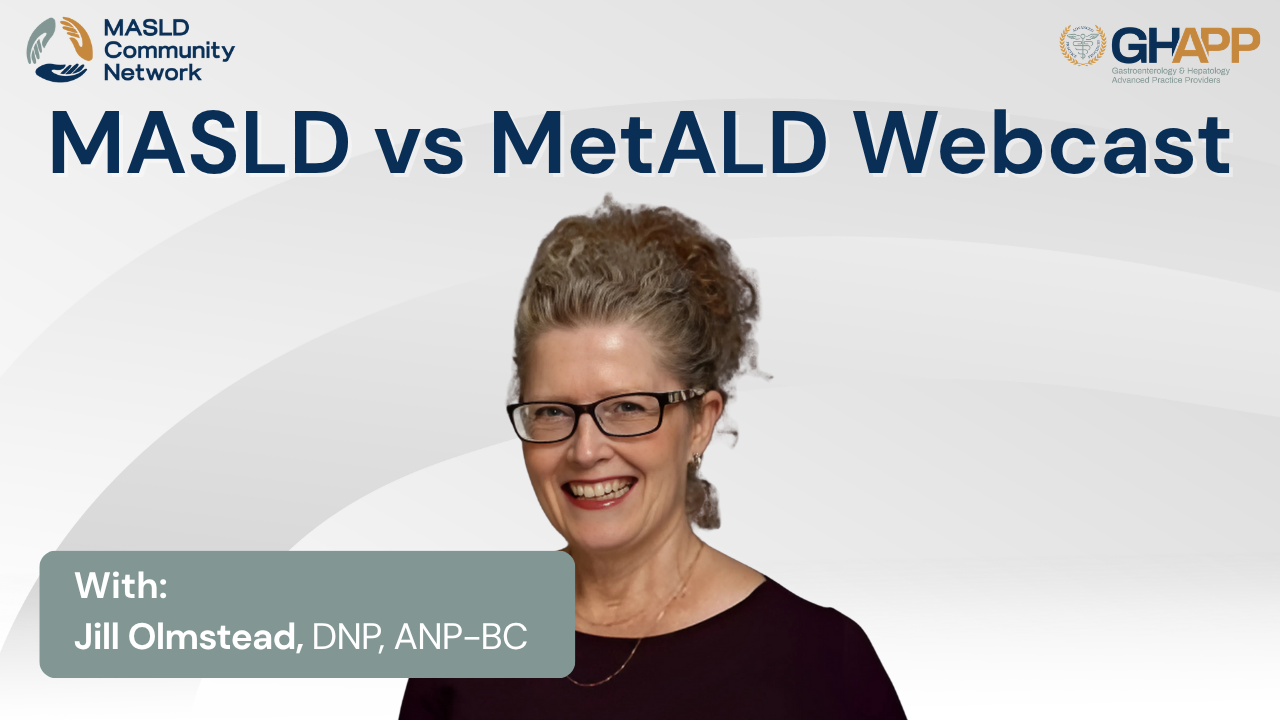
Webcast: MASLD vs MetALD With Jill Olmstead
November 2025
In this educational session, Jill Olmstead, DNP, from Providence Health in Southern California, reviews the new clinical guidelines for metabolic-associated steatotic liver disease (MASLD) and the emerging category MetALD—metabolic-associated liver disease related to alcohol use disorder. Through a case-based discussion, she explains how to evaluate patients with fatty liver disease, interpret key biomarkers like FIB-4 and FibroScan, and distinguish between metabolic and alcohol-related liver damage. Jill highlights the importance of weight loss, lifestyle modification, and alcohol cessation as essential interventions to reverse steatosis and fibrosis, and discusses the role of Resmetirom (Rezdiffra) as a newly approved therapy for patients with moderate to advanced fibrosis. This comprehensive overview helps clinicians and advanced practice providers apply updated MASLD and MetALD guidelines in everyday gastroenterology and hepatology practice.
Watch Now