


Chat with MASLD AI

Hi, I am MASLD AI.
Suggested Questions :
MASLD AI 07:16 AM

 October 2025

Stacie Egan, FNP-C, talks about new and emerging ways to treat MASLD and MASH, including healthy lifestyle changes, GLP-1 medications for weight loss and diabetes, and the first FDA-approved treatment, Resmetirom, for patients with liver scarring (fibrosis). She explains how these options can improve liver health, what to consider when prescribing them, and how to monitor progress with simple, non-invasive tests.
Related Webcast
Webcast: MASLD vs MetALD With Tessa Janovsky
 September 2025
Tessa Janovsky, PA-C, Arizona Liver Health, delivers a clear, case-based overview of metabolic dysfunction–associated steatotic liver disease (MASLD), MASH, and mixed-etiology MET-ALD. Using a common clinic scenario, she explains how to recognize fatty liver on imaging, why an accurate alcohol history matters, and how non-invasive tools (FibroScan stiffness/CAP and alcohol biomarkers like PEth) guide staging and care. You’ll learn practical, patient-friendly steps—Mediterranean-style nutrition, sustainable weight loss, regular aerobic and resistance exercise, and alcohol cessation—plus when to consider medications, specialist referral, and ongoing surveillance to prevent progression to advanced fibrosis and cirrhosis. Ideal for APPs and GI clinicians seeking straightforward strategies to manage MASLD/MASH in everyday practice.
Watch Now
Webcast: MASLD Pharmacotherapy With Chantil Jeffreys
September 2025
In this MASLD Community Network webcast, Chantil Jeffreys, FNP, walks through a practical framework for pharmacotherapy in MASLD/MASH—from lifestyle-first approaches to the evolving role of GLP-1 receptor agonists and bariatric/endoscopic options. She clarifies common misconceptions (e.g., statins are safe—and beneficial—for patients with fatty liver), reviews evidence and real-world considerations for vitamin E and pioglitazone, and explains where resmetirom (Rezdiffra) fits today for non-cirrhotic MASH with F2–F3 fibrosis—including monitoring, drug–drug interactions, and documentation tips that support payer approval. The session also covers cardiovascular risk reduction, peri-procedure guidance for GLP-1s, and practical strategies for staging and follow-up so clinicians can confidently personalize therapy and improve outcomes.
Watch Now
Webcast: Comparing F3 and F4 Fibrosis With Maly Tiev
September 2025
Maly Tiev, NP, reviews two real-world cases to explain the critical differences between F3 advanced fibrosis and F4 cirrhosis in patients with MASLD/MASH, and how accurate staging changes treatment, prognosis, and surveillance strategies. Using non-invasive tests (NITs) such as FIB-4, FibroScan/Liver Stiffness (kPa), CAP, and the ELF test, she demonstrates how concordant results can guide management without biopsy, when discordant results may require further imaging or histology, and why platelet count and bilirubin trends are key for identifying cirrhosis. For patients with F3, Maly highlights the importance of lifestyle modification with 7–10% weight loss, diet and exercise counseling, optimization of type 2 diabetes and lipid control, potential use of GLP-1 therapy, and when resmetirom (FDA-approved for MASH with F2–F3 fibrosis) may be considered, along with repeat NITs for monitoring. For patients with F4, management shifts to cirrhosis care, including twice-yearly HCC surveillance (ultrasound ± AFP), variceal screening guided by liver stiffness and platelet thresholds, and strict emphasis on alcohol avoidance and cardiometabolic risk reduction, noting that resmetirom is not used in cirrhotic patients. This case-based discussion provides clinicians, APPs, and hepatology teams with practical tools to approach staging, risk stratification, and surveillance in MASLD/MASH.
Watch Now
Webcast: Lifestyle Management With Whitney Steinmetz
July 2025
In this case-based clinical discussion, Whitney Steinmetz, FNP from Presbyterian Medical Group in Albuquerque, New Mexico, offers an in-depth review of lifestyle management strategies for patients with MASLD and MASH. Using the case of a 65-year-old male with persistently elevated ALT and metabolic syndrome, she highlights the importance of individualized, culturally competent counseling around nutrition, exercise, and behavioral change. Steinmetz outlines how tools like the FIB-4 score and FibroScan can help guide management and determine fibrosis risk, while emphasizing the critical role gastroenterology providers must play in addressing obesity, insulin resistance, and dietary habits. From the utility of motivational interviewing and realistic meal planning to the integration of caloric restriction and personalized exercise, this presentation equips clinicians with practical tools to support sustainable behavior change in patients with metabolic liver disease. Genetic factors, social determinants of health, and patient empowerment are all addressed, offering a holistic perspective on disease progression and prevention.
Watch Now
Webcast: MASLD vs MetALD With Anthony Derencius
November 2025
Join Anthony Derencius, PA-C for a concise, case-based update on steatotic liver disease—covering MASLD vs MetALD, how to interpret FibroScan (kPa/CAP), and when to use PEth to objectively quantify alcohol intake. Using a typical patient scenario (ultrasound steatosis, metabolic risk factors, daily wine), Anthony outlines practical steps for risk stratification, lifestyle and alcohol counseling, and monitoring advanced fibrosis, with clear thresholds to distinguish metabolic-predominant from alcohol-associated disease.
Watch Now
Webcast: MASLD vs MetALD With Valerie Shin
September 2025
Valerie Shin, NP from UCLA Health’s Pfleger Liver Institute, hosts a clear, practical overview of MASLD, MASH, and mixed-etiology MET-ALD for the GHAPP MASLD Community Network (sponsored by Madrigal). Through a common patient case, she explains how to recognize steatotic liver disease, why getting an accurate alcohol history matters, and how non-invasive tools (like FibroScan and alcohol biomarkers) help confirm what’s driving liver injury. You’ll hear straightforward guidance on counseling patients: heart-healthy/Mediterranean-style eating, sustainable weight loss, regular aerobic and resistance exercise, and complete alcohol cessation—plus when to consider specialty referral and ongoing surveillance. Perfect for APPs and GI clinicians seeking a simple, patient-centered approach to preventing progression from fatty liver to advanced disease.
Watch Now

Webcast: MASLD Basics With Cheryl Walsh
October 2025
In this MASLD Basics session of the MASLD & MASH Community Network, Cheryl Walsh, ACNP-C explains the new steatotic liver disease (SLD) nomenclature and how to apply it in practice. She clarifies definitions of MASLD, distinguishes MASH, and introduces overlap with MetALD by reviewing practical alcohol-intake thresholds. Cheryl outlines a stepwise primary-care pathway: start with FIB-4 to risk-stratify fibrosis, then use noninvasive tests such as elastography or the ELF blood test, with ultrasound/MRI as needed—and consider liver biopsy only for discordant or indeterminate results. You’ll learn when to reassess (F0–F1 every 2–3 years; F2–F3 annually with consideration of pharmacotherapy), when to refer to hepatology, and why fibrosis—not steatosis alone—drives prognosis. The talk also highlights global epidemiology, the stigma-reducing benefits of the new terminology, and patient counseling on lifestyle change (Mediterranean-style nutrition, activity, weight management) to alter disease trajectory.
Watch Now
Webcast: MASLD vs MetALD With April Morris
November 2025
Join April Morris, NP for a case-based walkthrough of updated steatotic liver disease concepts—MASLD, MASH, and MetALD—using a typical patient (“Ashley”) to illustrate real-world evaluation and management. Learn how to interpret FibroScan (e.g., kPa 11.4, CAP 310), spot metabolic risk (PCOS, HTN, dyslipidemia), and use alcohol biomarkers like PEth to uncover under-reported intake. April covers practical counseling—Mediterranean diet, exercise, weight loss—why alcohol abstinence is critical, when Resmetirom may be appropriate for non-cirrhotic fibrosis, and the need for HCC screening in advanced disease.
Watch Now
Webcast: MASLD Basics With Gabriella McCarty
August 2025
In this educational session, Gabriella McCarty, NP-C at Oshi Health, shares practical insights into Metabolic Dysfunction-Associated Steatotic Liver Disease (MASLD) and MASH. Drawing from over 25 years of experience in GI, IBD, and hepatology, she explains how many fatty liver patients are discovered incidentally during workups for unrelated issues such as GERD or routine colonoscopy. Gabriella reviews the new global terminology (MASLD replacing NAFLD, MASH replacing NASH), outlines key metabolic risk factors that define MASLD, and walks through the role of non-invasive tests (FIB-4, FibroScan, ELF, ultrasound) in staging fibrosis. She emphasizes the importance of early detection, patient education, and primary care involvement in identifying at-risk individuals before progression to advanced fibrosis, cirrhosis, or liver cancer. This presentation highlights how MASLD can silently progress, why primary care and GI collaboration are critical, and the growing need for global awareness and prevention of progressive liver disease.
Watch Now
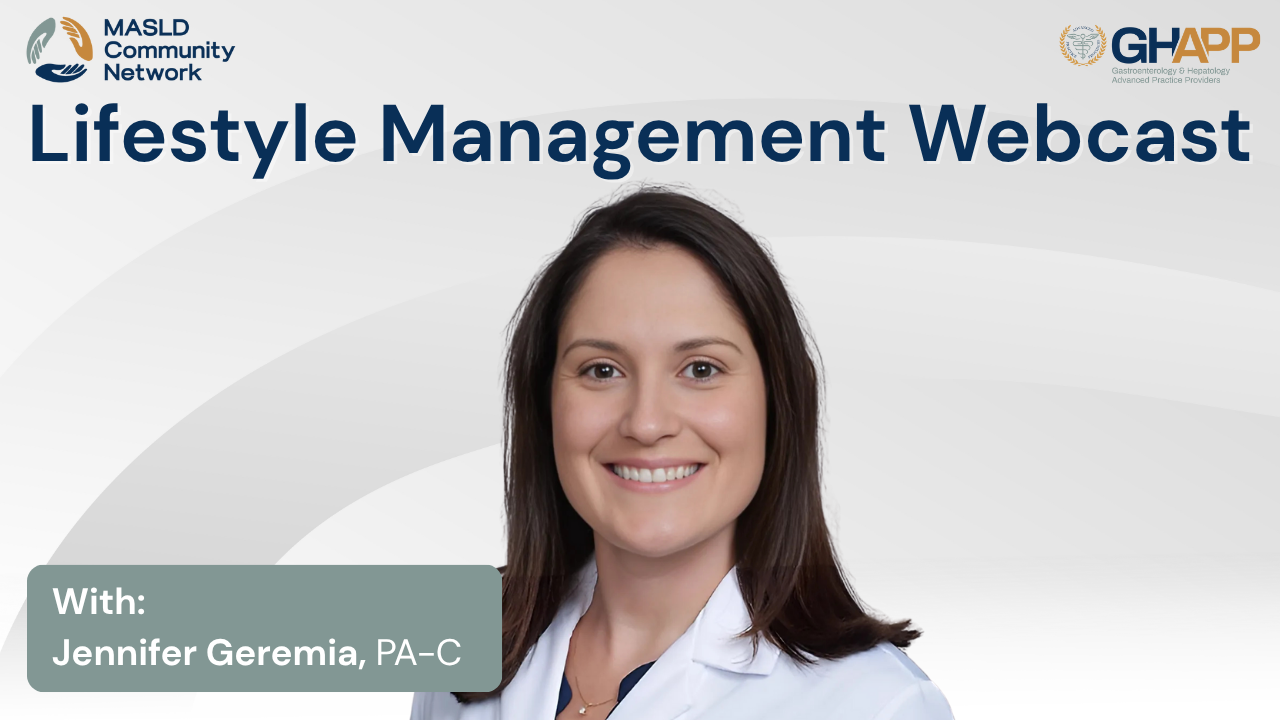
Webcast: Lifestyle Management With Jennifer Geremia
August 2025
In this GHAPP MASLD Community Network presentation, Jennifer Geremia, PA-C, from Brigham and Women’s Hospital in Boston, discusses the critical role of lifestyle modifications in managing MASLD (Metabolic Associated Steatotic Liver Disease) and MASH (Metabolic Associated Steatohepatitis). Using a case-based approach, she highlights how patients with obesity, type 2 diabetes, hypertension, and hyperlipidemia can benefit from evidence-based interventions including dietary changes, weight reduction, and physical activity. The session emphasizes the importance of achieving and maintaining 7–10% weight loss, the benefits of a Mediterranean diet, and combining aerobic and resistance exercise to improve liver health and reduce progression to advanced fibrosis or cirrhosis. Jennifer also explores the challenges of long-term adherence, the impact of genetic and metabolic risk factors, and strategies for engaging patients in realistic and sustainable lifestyle changes. This program underscores how early intervention and multidisciplinary care can prevent liver disease progression and improve outcomes for at-risk patients.
Watch Now