


Chat with MASLD AI

Hi, I am MASLD AI.
Suggested Questions :
MASLD AI 06:59 AM

 November 2025

In this educational session, Jill Olmstead, DNP, from Providence Health in Southern California, reviews the new clinical guidelines for metabolic-associated steatotic liver disease (MASLD) and the emerging category MetALD—metabolic-associated liver disease related to alcohol use disorder. Through a case-based discussion, she explains how to evaluate patients with fatty liver disease, interpret key biomarkers like FIB-4 and FibroScan, and distinguish between metabolic and alcohol-related liver damage. Jill highlights the importance of weight loss, lifestyle modification, and alcohol cessation as essential interventions to reverse steatosis and fibrosis, and discusses the role of Resmetirom (Rezdiffra) as a newly approved therapy for patients with moderate to advanced fibrosis. This comprehensive overview helps clinicians and advanced practice providers apply updated MASLD and MetALD guidelines in everyday gastroenterology and hepatology practice.
Related Webcast
Webcast: MASLD Pharmacotherapy With Christina Hanson
 September 2025
Learn about the latest advances in MASLD and MASH pharmacotherapy in this educational session from the GHAPP MASLD Community Network. Christina Hanson, NP, reviews the evolving landscape of treatment for metabolic dysfunction-associated steatotic liver disease (MASLD) and steatohepatitis (MASH), including the critical role of weight loss, cardiovascular risk reduction, and liver-directed therapies. The discussion covers current management strategies such as GLP-1 receptor agonists, bariatric interventions, statins, and lifestyle modification, while also exploring guideline-supported options like vitamin E and pioglitazone. Special attention is given to the first FDA-approved therapy for MASH, Resmetirom, including its mechanism, clinical trial results, safety considerations, and monitoring recommendations. Whether you are a hepatology specialist, primary care provider, endocrinologist, or advanced practice provider, this session highlights practical approaches to managing patients with MASLD and MASH and offers insights into emerging therapies that may shape future clinical practice.
Watch Now
Webcast: MASLD vs MetALD With Kelly Smeester
September 2025
In this session from the GHAPP MASLD Community Network, Kelly Smeester, PA-C at South Denver Gastroenterology, reviews a patient case to highlight the overlap between metabolic dysfunction–associated steatotic liver disease (MASLD) and metabolic dysfunction plus alcohol-associated liver disease (MetALD). Using real-world labs, FibroScan values, CAP scores, and the PEth biomarker, she explains how clinicians can distinguish MASLD from MetALD and alcohol-related liver disease. The discussion covers key metabolic risk factors such as PCOS, hypertension, and hyperlipidemia, the impact of moderate alcohol intake, and how these drivers accelerate fibrosis progression and increase the risk of decompensation. Viewers will learn how to evaluate alcohol use through standardized definitions, clinical questionnaires, and biomarkers, as well as best practices for patient education, lifestyle counseling, and management, including diet, exercise, pharmacologic options, and hepatocellular carcinoma (HCC) surveillance. This case-based talk emphasizes why accurate diagnosis and objective assessment of alcohol consumption are essential for both clinical care and research in steatotic liver disease.
Watch Now
Webcast: MASLD Basics With Tessa Janovsky
August 2025
Join Tessa Janovsky, PA-C, from Arizona Liver Health, for this foundational session in the GHAPP MASLD Community Network, proudly sponsored by Madrigal Pharmaceuticals. This episode offers a comprehensive overview of the updated nomenclature and clinical approach to steatotic liver disease, covering the transition from NAFLD/NASH to MASLD (Metabolic Dysfunction-Associated Steatotic Liver Disease) and MASH (Metabolic Dysfunction-Associated Steatohepatitis). Tessa breaks down the rationale behind this global reclassification and explains how it improves diagnostic clarity while reducing stigma. You’ll learn how to identify MASLD using cardiometabolic risk factors, apply non-invasive risk stratification tools like FIB-4, FibroScan, and ELF, and determine when to refer patients for hepatology care. She also discusses the natural history of MASLD progression, the risk of cirrhosis and HCC, and the clinical importance of early detection and treatment. Real-world case studies guide providers through assessing common patient presentations, ruling out alternative etiologies, and considering pharmacologic therapy like resmetirom when appropriate. This is an essential watch for APPs, PCPs, and GI providers working to better understand and manage MASLD and MASH in clinical practice.
Watch Now
Webcast: Non-Invasive Testing With Patrick Horne
September 2025
In this case-based session, Patrick Horne, NP speaks about non-invasive testing (NITs) to stage MASLD/MASH without biopsy. Starting from a real patient, he shows how to triage with FIB-4, then advance to liver stiffness measurement—FibroScan/VCTE (kPa for fibrosis, CAP for steatosis)—and when to add ELF, MRE, and MRI-PDFF. You’ll learn which results flag advanced fibrosis vs. low risk, how to vet scan quality (≥10 valid measurements, clean parallel shear waves, acceptable IQR/median), and the common confounders that can inflate stiffness. Patrick maps decisions to AGA/AASLD-aligned pathways for referral, monitoring, and re-staging—and applies the algorithm to the case.
Watch Now

Webcast: Lifestyle Management With Jonathan Yeh
August 2025
In this GHAPP MASLD Community Network session, Jonathan Yeh, PA-C from Columbia University Irving Medical Center, presents a case-based discussion on the lifestyle management of MASLD (Metabolic Associated Steatotic Liver Disease) and MASH (Metabolic Associated Steatohepatitis). Through the case of a 65-year-old patient with obesity, type 2 diabetes, hypertension, and hyperlipidemia, Jonathan highlights how dietary modification, weight loss, and physical activity remain the foundation of treatment, even with new pharmacotherapies available. The presentation emphasizes the benefits of the Mediterranean diet, the importance of avoiding refined carbohydrates, and the role of both aerobic and resistance exercise in improving liver health, reducing steatosis, and potentially reversing fibrosis. Cultural considerations, patient adherence challenges, and strategies to drive behavior change are also addressed, providing clinicians with practical insights to support patients in preventing progression to advanced fibrosis or cirrhosis.
Watch Now
Webcast: Comparing F3 and F4 Fibrosis With Jessica Crimaldi
August 2025
In this educational session, Jessica Crimaldi, a nurse practitioner at Cleveland Clinic with nearly a decade of experience in gastroenterology and hepatology, walks through real-world cases comparing patients with F3 fibrosis and F4 fibrosis. She reviews how to assess disease severity using non-invasive tests like FIB-4, FibroScan, CAP scores, and ELF tests, and explains how clinical findings such as platelets, bilirubin, and INR can guide staging. Jessica highlights the differences in management between patients with advanced fibrosis versus cirrhosis, including the role of lifestyle modifications, GLP-1 therapy, statins, blood pressure control, and Resmetirom for eligible F2/F3 patients. She also discusses the importance of HCC surveillance, portal hypertension evaluation, esophageal varices screening, and long-term monitoring in cirrhosis care. This case-based learning approach offers practical insights into fatty liver disease, MASLD/MASH progression, and optimizing patient outcomes through accurate staging and tailored treatment strategies.
Watch Now
Webcast: MASLD Basics With Ellie Gonyeau
August 2025
Join Ellie Gonyeau, NP, a GI and hepatology nurse practitioner at Beth Israel Deaconess Medical Center in Boston, for a foundational overview of Metabolic Dysfunction-Associated Steatotic Liver Disease (MASLD), formerly known as NAFLD. Presented through the GHAPP MASLD Community Network and sponsored by Madrigal Pharmaceuticals, this session covers the latest updates in MASLD nomenclature, diagnostic criteria, and non-invasive evaluation strategies. Ellie walks through the 2023 guidelines, emphasizing how MASLD is defined by hepatic steatosis in the presence of at least one metabolic risk factor—such as obesity, type 2 diabetes, hypertension, or dyslipidemia—and the importance of ruling out excessive alcohol use and other causes of chronic liver disease. Using real-world case examples like "JP", Ellie illustrates how to assess disease severity using tools such as FIB-4, FibroScan, and lab workups, while explaining when to consider specialty referral, further imaging, or liver biopsy. The talk also highlights the alarming rates of MASLD in high-risk populations, such as the Latin American community, and explores the disease's potential to silently progress to MASH, fibrosis, or cirrhosis. Whether you're in primary care, GI, or hepatology, this session provides critical insights on early detection, risk stratification, and guideline-based management of this increasingly prevalent condition.
Watch Now
Webcast: MASLD vs MetALD With Alison Moe
November 2025
In this insightful session, Alison Moe, PA-C, from Atlantic Gastroenterology Associates, a division of United Digestive, breaks down how to distinguish metabolic-associated steatotic liver disease (MASLD) from MetALD—the overlap of metabolic dysfunction and alcohol-related liver injury. Using a real-world case study, Alison highlights how small amounts of daily alcohol intake can significantly accelerate fibrosis in patients with metabolic risk factors like PCOS, hypertension, and dyslipidemia. She explains how to interpret FibroScan (kPa/CAP) results, evaluate PEth testing for alcohol exposure, and determine when therapies such as Resmetirom are appropriate. This discussion emphasizes practical strategies for counseling patients on alcohol cessation, lifestyle modification, and fibrosis monitoring, helping clinicians better identify and manage those at risk for advanced liver disease.
Watch Now
Webcast: MASLD Pharmacotherapy With April Morris
August 2025
Join April Morris, NP, a hepatology and endocrinology nurse practitioner, for a comprehensive review of MASLD pharmacotherapy as part of the GHAPP MASLD Community Network. This expert-led session outlines a three-pronged strategy for managing Metabolic Dysfunction-Associated Steatotic Liver Disease (MASLD) and MASH, focusing on obesity reduction, cardiometabolic risk control, and liver-directed treatment. April walks through first-line lifestyle approaches, highlights key pharmacologic agents like GLP-1 receptor agonists, and explains their mechanisms and clinical relevance—including the groundbreaking data from the semaglutide trials showing resolution of MASH and improvement in liver fibrosis. The session also reviews the role and limitations of vitamin E and pioglitazone, emphasizing their risks in patients with diabetes or cardiovascular disease. The spotlight then shifts to resmetirom (Rezdiffra), a thyroid hormone receptor beta agonist FDA-approved for adults with non-cirrhotic NASH and moderate-to-advanced fibrosis (F2–F3). April explains the MAESTRO-NASH trial endpoints, clinical efficacy, common side effects, and appropriate patient selection. Learn how resmetirom improves fatty acid oxidation, reduces hepatic fat and fibrosis, and the key drug–drug interactions and statin dose considerations to manage during treatment. The discussion concludes with practical tips for monitoring, non-invasive staging (FibroScan, ELF, MRI-PDFF), and the evolving guidance on treatment duration, safety labs, and insurance barriers. This session is essential for clinicians navigating the growing landscape of therapeutic options in MASLD/MASH care.
Watch Now
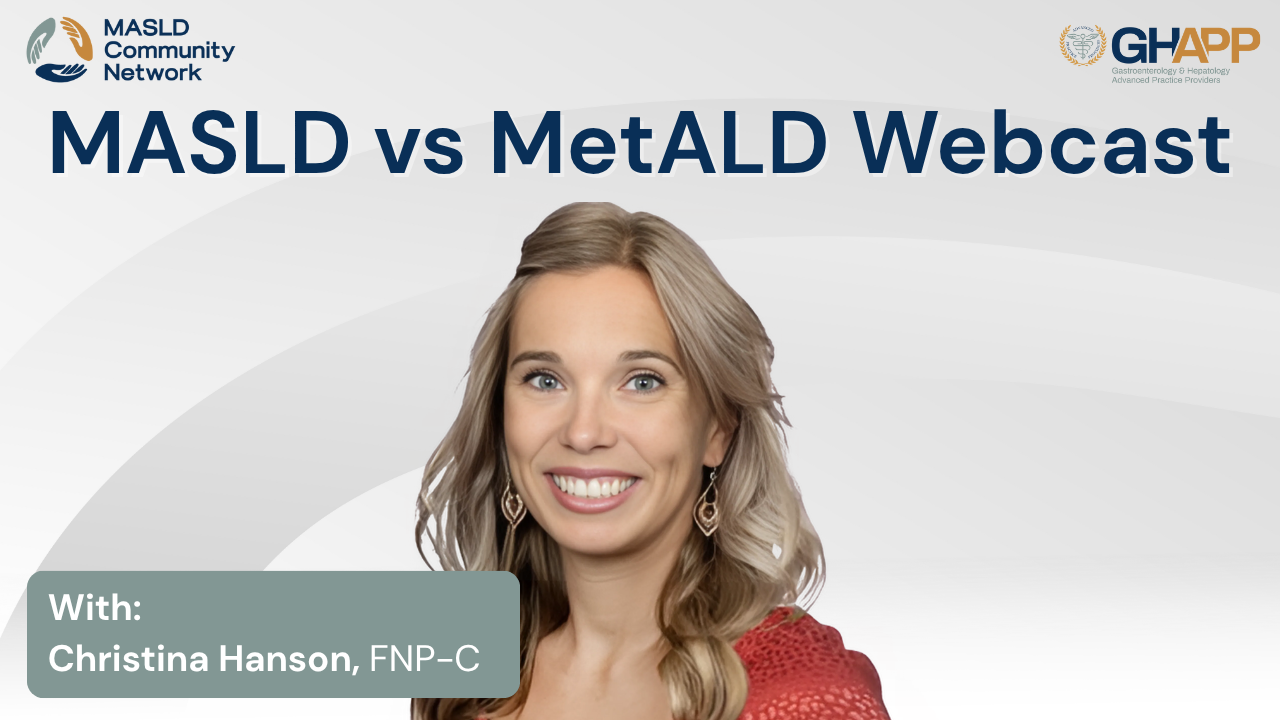
Webcast: MASLD vs MetALD With Christina Hanson
September 2025
Discover the latest insights on MASLD and MetALD in this educational session from the GHAPP MASLD Community Network. Christina Hanson, FNP-C, walks through a real-world case study to highlight how common metabolic conditions like hypertension, hyperlipidemia, obesity, and PCOS intersect with alcohol use to drive liver disease progression. The session explores updated nomenclature replacing NAFLD/NASH, the role of FibroScan and elastography in staging fibrosis, and the importance of screening patients with metabolic risk factors for fatty liver. Learn how alcohol consumption contributes to liver injury, triglyceride elevation, and blood pressure changes, and how objective biomarkers such as PEth testing are transforming diagnosis beyond self-reporting. Christina also reviews lifestyle interventions, dietary strategies like the Mediterranean diet, and current treatment considerations for patients with advanced fibrosis (stage 3), including when to initiate HCC screening. Whether you are a hepatologist, GI specialist, or advanced practice provider, this session provides practical tools for evaluating and managing patients with MASLD, MetALD, and related liver health challenges.
Watch Now